
Core Web Vitals in 2026: INP Is the Metric to Watch
Google tightened its performance standards this year and INP is now the metric most sites fail. Here is what each Core Web Vital means and how we get sites to pass. Gaurav Pandey
- 2026-01-22
Core Web Vitals are the three numbers Google uses to judge whether your site feels fast and stable to a real person. They feed into search rankings, and in 2026 they matter more than they ever have. Google tightened the standards this year, and a lot of sites that used to scrape a pass are now failing.
If you only remember one thing from this post: the metric tripping up most sites right now is INP, and it is the one worth your attention.
The three metrics, in plain language
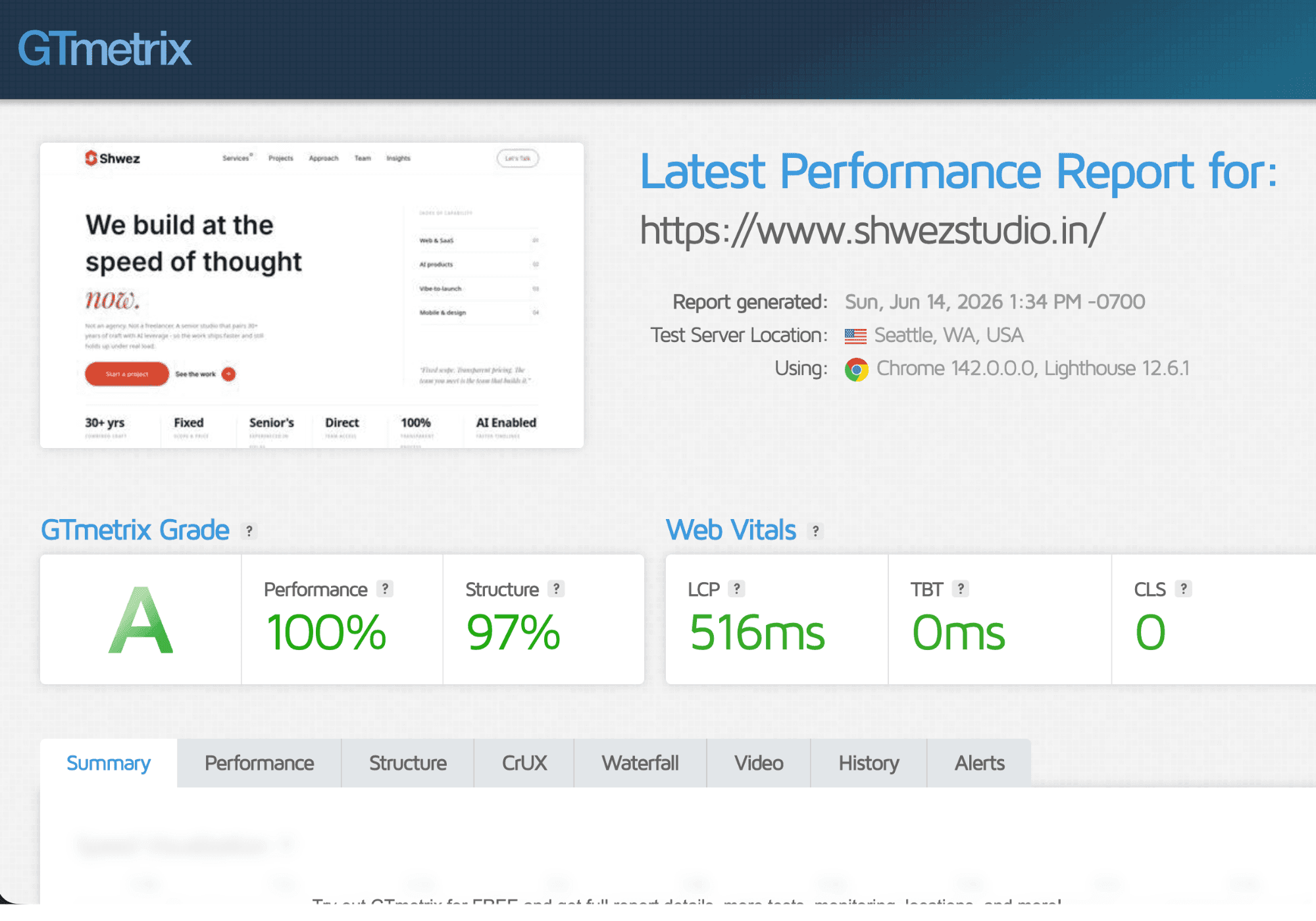
Largest Contentful Paint, or LCP, measures how long it takes for the main content of a page to show up. The target is under 2.5 seconds. This is mostly about loading: big images, slow servers, and render-blocking scripts are the usual culprits.
Interaction to Next Paint, or INP, measures how quickly the page responds when someone taps or clicks. The target is under 200 milliseconds. INP replaced the old First Input Delay metric, and it is stricter because it looks at every interaction across a visit, not just the first one.
Cumulative Layout Shift, or CLS, measures how much the page jumps around while it loads. The target is under 0.1. You have felt bad CLS yourself: you go to tap a button, an ad loads above it, and you tap the wrong thing. That is a layout shift.
Why INP is the hard one
Roughly 43 percent of sites still fail the 200 millisecond INP threshold, which makes it the most commonly failed Core Web Vital this year. The reason is that INP is about JavaScript doing too much work on the main thread. Every heavy script, every bloated third-party widget, every analytics tag that fires on click adds to the delay.
LCP and CLS are often fixable with better images and reserved space. INP forces you to actually look at how much code runs when a user interacts, and for many sites that means trimming things they have been carrying around for years.
What good performance is worth
This is not a vanity exercise. Slow pages lose money. Page speed studies in 2026 keep landing on the same conclusion: when a page gets slow, people leave, and conversions drop with them. Google has been clear about the message too, which is that fast sites win, both in rankings and in revenue.
There is also a framework angle that is hard to ignore. Next.js sites pass Core Web Vitals at around 58 percent, compared to about 38 percent for WordPress. The tooling you start with shapes how easy these numbers are to hit. That is one of the reasons we reach for a modern framework on most builds rather than fighting a slow stack later.
How we actually fix these
There is no single switch. The work is a series of unglamorous improvements.
For LCP we serve properly sized images in modern formats, lazy-load anything below the fold, and make sure the server responds quickly. For CLS we set explicit dimensions on images and reserve space for anything that loads late, so nothing shoves the layout around. For INP we audit the JavaScript, cut or defer third-party scripts, and break up long tasks so the browser can respond to taps without waiting.
The order matters. We measure first using field data from real visitors, not just a lab score, then fix the metric that is costing the most. Chasing a perfect lab score while ignoring how the site feels on a mid-range phone on a patchy connection is a common trap.
The takeaway
Treat Core Web Vitals as a product metric, not an SEO afterthought. A site that loads fast, responds instantly, and stays still while it loads simply feels better to use, and Google rewards that. If your site is failing INP right now, you are in the majority, and it is fixable. It just takes someone willing to look at what all that code is doing.